Protocols and papers
State Transition Protocol v1.1
The earlier version of the State Transition Protocol, the source of the five STP figures, and the formal baseline that the v1.2 candidate proposes to change.
Open source independent research · CC BY 4.0
- Printed title
- State Transition Protocol: a framework architecture for controlled state transitions in agentic systems
- Format
- PDF, 28 pages
- Date
- 10 August 2026
- Structure
- 14 numbered sections, Appendices A to C, Figures 1 to 5
What it means
A model can propose a change and a tool can apply it, but accepted state advances only through a declared projection rule after the required evidence, authority, observation, and conflict checks.
The protocol keeps world, observed, candidate, accepted, and desired state as separate records and gives each control function its own receipt. Its deterministic claim is narrow: identical valid events, ordering rules, schemas, and policy versions produce the same accepted projection.
Accepted state advances only through a declared projection rule after the required evidence, authority, observation, and conflict checks.
Page 1
Candidate synthesis. Literature convergence supports relevance. Evaluation and independent review remain required.
Page 2
How it functions
A consequential change is written as a typed delta and moves along one consequence path (Figure 1): PROPOSE, NORMALIZE, CHECK, AUTHORIZE, PREPARE, EXECUTE, OBSERVE, ACCEPT, OUTCOME, CORRECT. A failed gate records a refusal and preserves the prior accepted projection.
To check the design, use its 15 deterministic fixtures (F01 to F15), its falsification conditions, its enforcement levels from a review card to independent witnessing, and the 12 architecture decisions in Appendix C. The document's own fast path is Sections 2, 3, 4, 7, and 11.
Status and claim boundary
The printed status is Open source independent research, released for independent review and reproducible testing under CC BY 4.0. Appendix C marks its 12 architecture decisions (D01 to D12) as approved for version 1.1. The document calls its contribution a candidate synthesis that still needs evaluation and independent review.
It provides a control model, fixtures, and design targets. It reports no fixture results from an implementation, and it does not establish external truth, safe outcomes, witness quality, or legitimate authority; a deployment must supply those.
Version history: a v1.2 candidate (PROPOSED, owner review required) is the working version under owner review. STP v1.1 remains the current baseline until an owner receipt records a decision on v1.2.
Figures from this paper
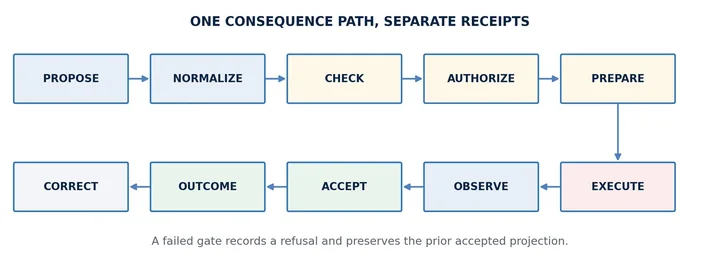 STP v1.1, Figure 1: One consequence path, separate receipts
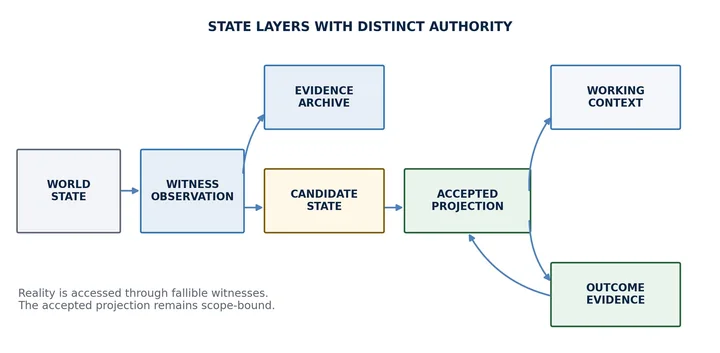 STP v1.1, Figure 2: State layers with distinct authority
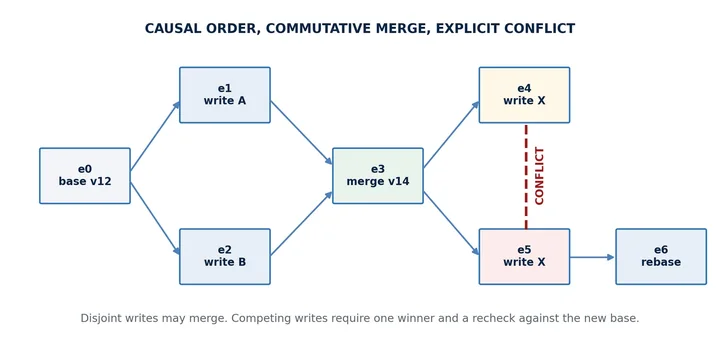 STP v1.1, Figure 3: Causal order, commutative merge, explicit conflict
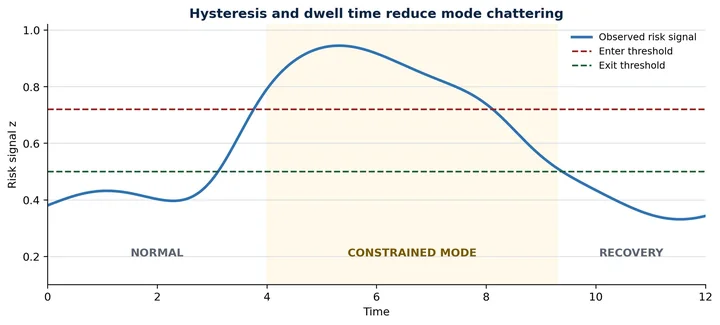 STP v1.1, Figure 4: Hysteresis and dwell time reduce mode chattering
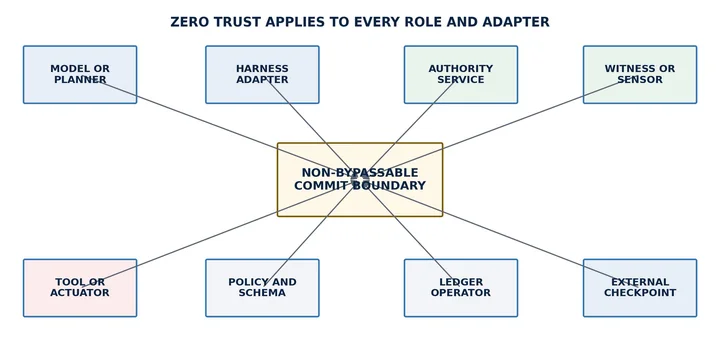 STP v1.1, Figure 5: Zero trust applies to every role and adapter